South Korea (Korea) has seen several notable trends in merger review and enforcement that companies engaged in global transactions should be aware of. The following provides an overview of merger review statistics in 2025 published by the Korea Fair Trade Commission (KFTC), along with an analysis of recent developments companies should consider when filing in Korea.
1. Overview of Merger Review Statistics in 2025
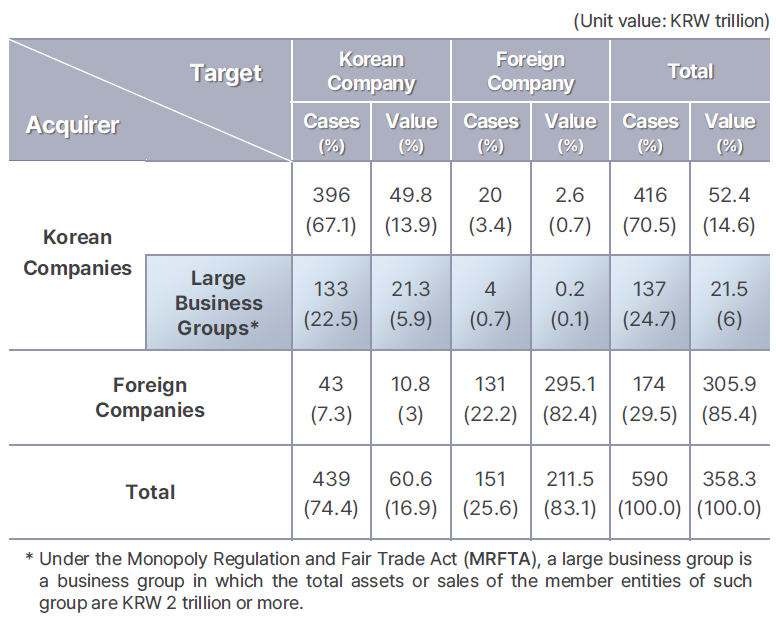
The KFTC reviewed a total of 590 merger filings, marking a decrease of 208 cases (26%) compared to 2024 (798 cases). The decrease in the total number of merger filings reviewed is likely attributable to the implementation of merger filing exemptions by the KFTC for transactions involving (i) statutory mergers or business transfers between a parent company and its subsidiary under the Commercial Code, (ii) the establishment of a private equity fund under Korean law, and (iii) interlocking directorates involving less than 1/3 of the directors of the counterparty (excluding the CEO). Notwithstanding the marked decrease in merger filings, the aggregate transaction value increased from KRW 276.3 trillion in 2024 to KRW 358.3 trillion in 2025, an increase of 30%, indicating that large-scale transactions were more common in 2025. This increase in transaction value is attributable to the significant 38% rise in the aggregate transaction value of merger filings involving foreign companies, which increased from KRW 221.1 trillion to KRW 305.9 trillion.
The breakdown of merger cases reviewed and their transaction values, categorized by the nationality of the parties and their affiliation with large business groups, is presented in the table below.
On the other hand, the number of in-depth merger reviews to determine whether transactions restrained competition increased from 31 cases in 2024 (3.9% of merger filings) to 50 cases in 2025 (9.8% of merger filings). The significant increase of in-depth merger reviews despite the 26% decrease in total number of mergers reviewed is likely due to the KFTC focusing on select cases with the potential for anticompetitive effects.
2. Remedies and Non-compliance Penalties
Of the 50 merger filings subject to in-depth review by the KFTC in 2025, the KFTC imposed remedies in three cases. Additionally, the KFTC blocked one transaction recently in 2026 as discussed in detail below. Furthermore, the KFTC has demonstrated a strict approach to enforcing compliance with remedy orders.
1) Acquisition of Shares in the Semiconductor Chip Design Software Market – Conditional Clearance Subject to Divestiture
The KFTC conditionally approved the acquisition by Synopsys (a leading global semiconductor chip design software company) of all shares in Ansys subject to remedies. The KFTC perceived the merger to have a significant impact on the Korean market, as the parties supply software used by Korean companies such as Samsung Electronics and SK Hynix to design semiconductor chips or various other products using optics and photonics. During the merger review, the KFTC collected the opinions of various interested parties, both Korean and foreign, and received technical advice from experts.
Based thereon, the KFTC determined that the horizontal merger, could substantially restrict competition in the markets for (i) register-transfer level (RTL) power consumption analysis software, (ii) optical product design software, and (iii) photonics design software - where the combined market share of the two companies was between 60% to 80%, 90% to 100%, and 55% to 75%, respectively - potentially resulting in consumer harms such as increases in price or unfavorable transaction conditions. Accordingly, the KFTC imposed remedies requiring the divestiture of all relevant assets of either Synopsys or Ansys in each of the affected markets.
This case marks the first application of the "voluntary commitment procedure" introduced in August 2024, under which the parties may propose an official remedy package to the KFTC (see
here →). Following the submission of the proposed remedies by the parties, the KFTC collected the opinions of competitors and customers, and revised the remedies where further supplementation was deemed necessary. As the case could have a significant impact on the global semiconductor design software market, the KFTC’s review involved close coordination with competition authorities in the United States, the EU, and the United Kingdom, among others, which resulted in the imposition of similar remedies with other competition authorities.
2) Interlocking Directorate in the Paid Subscription OTT Service Market – Conditional Clearance Subject to Behavioral Remedies
The KFTC conditionally approved a transaction involving interlocking directorates whereby Tving’s directors would comprise of five of Wavve's eight directors (including the representative director) and one statutory auditor. In Korea, Tving is the second-largest operator in the paid subscription OTT service market and Wavve is the fourth-largest operator by number of subscribers. The KFTC determined that the transaction raised concerns of subscription fee increases. Accordingly, the KFTC imposed remedies requiring each company to maintain its current pricing plans through the end of 2026, and, in the event of service integration, to launch pricing plans substantially similar to existing ones and maintain them through the end of 2026. The remedies are intended to prevent potential harm to OTT subscribers – such as price increases – that could arise from a horizontal merger between OTT service providers, thereby protecting OTT subscribers while preserving the parties’ pro-competitive rationale of the transaction, which is the enhancement of content acquisition and production capabilities. The behavioral remedies imposed by the KFTC are relatively short-term (through the end of 2026) as the KFTC considered that Tving and Wavve would face competition from Netflix, Coupang Play, and Disney+.
The parties successfully used the voluntary commitment procedure in this case to obtain conditional approval.
3) Establishment of a Joint Venture in the Domestic Online Cross-Border Shopping Market – Conditional Clearance Subject to Behavioral Remedies
The KFTC conditionally approved the establishment of a joint venture by Gmarket (operator of major domestic e-commerce platforms “Gmarket” and “Auction”) and AliExpress (global direct purchasing platform) through which the two companies would jointly control the platforms previously operated independently by each company, subject to the behavioral remedy of prohibiting the exchange of Korean consumer data between Gmarket and AliExpress.
During its review, the KFTC conducted an in-depth review of the transaction, which included collecting the opinions of foreign and Korean competitors, relevant industry participants, and experts, and conducted a consumer perception survey. The merger review focused on the potential for a substantial lessening of competition in the Korean cross-border e-commerce (overseas direct purchase) market, where Gmarket and AliExpress competed. In the Korean online cross-border e-commerce market, AliExpress had the largest market share of 37.1%, while Gmarket was the fourth largest with a 3.9% market share, meaning the combined market share of the joint venture was 41%.
The online cross-border e-commerce market is characterized by a feedback loop in which the accumulation of user data leads to improvements in targeted advertising and service quality, which in turn attracts additional users. In this regard, the KFTC was concerned the transaction could amplify platform-specific network effects (where an increase in users attracts more sellers which further increases users), resulting in an increased user concentration on the Gmarket – AliExpress joint venture platforms and a strengthening of market power. In addition, the KFTC determined the strengthening of consumer lock-in effects for Gmarket and AliExpress following the merger could operate as a factor in reducing the joint venture’s incentives to maintain the quality of personal data protection and data security.
Based on the foregoing, the KFTC determined there were potential concerns on the restriction of competition from the combination of data. As a result, the KFTC imposed remedies requiring the independent operation of the two platforms, the technical separation of Korean consumer data, a prohibition on the cross-use of data within the Korean market, and the maintenance of existing personal data protection standards for 3 years which may be extended depending on market conditions.
This case marks the first instance in which remedies were designed based on an assessment of the anticompetitive effects of combining data in a digital market, and is unique as the KFTC took the approach of treating personal data protection and data security efforts as key non-price parameters of competition. The parties also used the voluntary commitment procedure to obtain conditional approval.
4) Merger of Korean Car Rental Companies (January 2026) – Merger Blocked
In January 2026, the KFTC blocked a merger between the largest (Lotte Rental) and second-largest (SK Rent-a-Car) car rental companies in Korea. Although the combined market share of the two companies ranged from 21.3% to 38.2% (depending on the relevant markets), the KFTC, basing its decision on economic analysis, the submission of opinions from interested parties, and extensive consumer surveys, determined the companies were each other’s closest competitors and that the transaction would create a company with market power. Furthermore, the remaining competitors, primarily small and medium-sized enterprises, were found to be unlikely to exert effective competitive pressure post-merger to compete with the merged entity.
The KFTC also stated that behavioral remedies would be inappropriate in addressing the anticompetitive concerns since (i) structural remedies are preferred in cases with significant competition concerns and (ii) post-transaction, as the private equity fund will control the merged entity and due to the nature of private equity ownership, it will be difficult to ensure the continuity of the merged entity’s compliance with behavioral remedies.
This case demonstrates that even in transactions where the relevant market shares are modest and not high enough to trigger a statutory presumption of anticompetitive effects under the MRFTA, the KFTC may levy structural remedies or even block a transaction based on factors including market characteristics, industry structure, and unilateral effects.
5) Imposition of Periodic Penalty Payments for Non-Compliance with Remedies
The KFTC has been particularly active in monitoring and enforcing non-compliance with imposed remedies. The KFTC continued to assess compliance with the behavioral remedies imposed in connection with the Korean Air-Asiana Airlines merger, such as the prohibition of fare increases and reduction of seat capacity which were ordered for compliance until the completion of structural remedies, which includes the transfer of slots and traffic rights on certain routes. To confirm compliance, the KFTC not only reviewed reports submitted by the companies but also frequently requested the submission of data and conducted several dawn raids.
The KFTC imposed periodic penalty payments of KRW 5.88 billion (approximately USD 4.11 million) on Korean Air for non-compliance by violating its obligation not to reduce seat capacity and KRW 12.68 billion (approximately USD 8.85 million) on Asiana Airlines for violating its obligations not to reduce seat capacity and not to exceed the cap on average seat fare increases. The penalties imposed by the KFTC are the largest non-compliance penalties imposed for merger remedies. This case demonstrates the KFTC’s tendency to interpret remedies strictly and closely scrutinize their implementation.
3. Takeaways
The KFTC's 2025 merger review statistics may be summarized as follows: while the number of filings declined, the intensity of review increased, particularly for large-scale M&A transactions. This decline is attributable in part to the expansion of merger filing exemptions introduced in August 2024, which reduced the number of straightforward cases reviewed by the KFTC. The exemptions allowed the KFTC to concentrate its resources on significant transactions with major implications for the Korean market, reflecting a more targeted and focused enforcement approach.
Of particular note, remedies regarding personal data - such as the requirement to maintain data security standards - were imposed for the first time, making a departure from more conventional remedies such as asset divestitures typically applied to horizontal mergers raising competition concerns. This development suggests that the KFTC is more likely to review mergers and impose remedies from a broader perspective than in the past, such as by considering non-price parameters of competition, to reflect the unique characteristics of digital markets. Furthermore, the KFTC’s oversight of the implementation of remedies has become increasingly stringent. The KFTC has recently stated it will review institutional reforms to enhance the effectiveness of enforcing remedies, which indicates that the KFTC intends to monitor rigorously the implementation of remedies and impose harsh penalties for non-compliance moving forward.
In conclusion, companies that expect to submit merger filings in Korea should consider these recent developments and current trends in merger review and enforcement by the KFTC. In transactions involving potential anticompetitive concerns, the parties should conduct a thorough assessment of the potential impact on the relevant markets, develop persuasive arguments to address potential anticompetitive effects, prepare remedy packages to submit to the KFTC, and consider the possibility of extended review periods that could impact business considerations such as closing dates for the parties. Also, companies should consider utilizing the recently implemented pre-notification procedure (at least two weeks prior to the submission of a merger filing, the parties may consult with the KFTC regarding substantive issues (see
here →)) and voluntary commitment procedure to reduce potentially the period of merger reviews.
Lee & Ko’s Antitrust and Competition Practice Group is continuously monitoring and analyzing amendments to the MRFTA, regulations and KFTC enforcement trends. Our team possesses the expertise and experience required to provide the latest and most comprehensive legal advisory services to meet the needs of our clients. If the need for assistance with similar or other antitrust and competition law matters should arise, please contact Lee & Ko’s Antitrust & Competition Practice Group.